
Why Brands Are Thinking Bigger Through The Psychology Of Large-scale Visual Marketing
Written by: Jeff H. of TEAM Concept Printing
Large-scale visual marketing might seem archaic given the ubiquity of digital ads, but the reality is that industry analysts are seeing brands implement it as a calculated response to the increasing fragmentation of human attention.
Driven by the over 392 billion daily emails and the $781 billion spent on online promotional activities each year, consumers have begun to adapt their minds to automatically filter out so much of the small-scale stimuli they’re bombarded with. Thus, real-world marketing using traditional, physical display methods and psychologically tuned design techniques has the power to cut through the low-level cacophony of digital marketing.
Part of the trend comes down to a maturing understanding of how the psychology of brand visuals works at scale, on posters, billboards, video screens, and so forth.
TEAM Concept Printing & Packaging, a printing services provider based in Chicago, examines the psychological principles behind large-scale visual marketing.
Why Say It With Signage
Brands are committed to large-scale visual marketing in a big way, and details of the billboard and outdoor advertising industry indicate just how prevalent it is globally. Grand View Research estimated the size of this market at over $41 billion in 2025, while predicting that by 2033 it will exceed $78 billion, with annual growth of 8.4% cementing its significance.
Most impressively, custom printed static billboards account for the largest single slice of this market, at 28.1% last year. So, while crowds in Times Square might gape at the vast screens and their all-singing, all-dancing animated ads, the bread and butter of this niche is less flashy, but just as impactful.
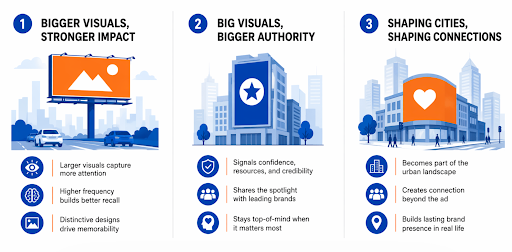
From a psychological perspective, scale is important for obvious reasons. When visual marketing occupies more of a consumer’s line of sight, they are innately more engaged. It’s the same reason that watching a movie in IMAX at a theater leaves more of an impression than consuming the same content on a smartphone.
More than that, research shows that frequency is just as important as size. A 2017 Nielsen study found that using at least 40 large-scale visual ads increased recall among general audiences.
A similar 2024 study on ad memorization reached similar conclusions: People have better recall for what they’ve seen when it's repeated regularly over a short span. Researchers also found that variety was important for memorability, with information conveyed through more distinctive visual designs being more likely to be retained.
Many brands stand to benefit from understanding the advantages of large-scale visual marketing. The opportunity to engage prospective customers, enhance brand recognition, and provide useful information simultaneously should not be overlooked.
Establishing Authority
There’s another psychological benefit to going big with visual marketing, and it’s not tied to the immediate impact on brand recognition and recall. Instead, it’s the adjacent message that underpins any organization that runs a conspicuous campaign in a specific area: We’ve got the resources, know-how, and confidence in our product to spread our message loud and proud.
Consumers associate visual ads with multinational brands, so companies that share the same platforms benefit from this reputational boost by association. When major players throw their weight behind a platform, minor players receive similar public kudos when they adopt the same strategy.
Moreover, a large-scale visual marketing piece might not prompt an immediate conversion the way a digital ad does. However, even if a consumer does not interact with the brand there and then, the sheer scale of the visual ensures that the brand is the top-of-mind representative for its category. When the need for a specific service or product eventually arises, the brain naturally gravitates toward the most visually dominant memory it has stored.
The transition to larger visuals is also a response to the tiny-screen problem. As most content is consumed on handheld devices, the impact of professional photography and design is often lost. Reclaiming the physical world allows designers to use detail and color theory at a resolution that commands attention and evokes a visceral, rather than just intellectual, response.
A New Era for Urban Brand Interaction
As urban environments continue to evolve, the integration of brand visuals into the architectural fabric of cities will likely intensify. The psychology of large-scale marketing suggests that the most successful brands of the next decade will be those that understand how to occupy space without creating visual clutter. This involves a delicate balance between being bold enough to be noticed and being aesthetically integrated enough to be welcomed.
Future marketing strategies are expected to lean further into these environmental triggers, using scale to create landmarks rather than just advertisements. When a visual becomes a part of a city's identity, the brand achieves a level of permanence that no digital campaign can match.
where to order large-format signage?
In a world where attention is fragmented and competition is constant, thinking bigger isn’t just a creative choice, it’s a strategic advantage. Large-scale visual signage taps directly into how people see, feel, and decide, turning everyday environments into powerful brand experiences. When executed with intention, these visuals get noticed and influence behavior, build memory, and drive action in real time. That’s where partnering with TEAM Concept Printing makes the difference. With industry-leading large-format printing capabilities, in-house production, and a commitment to quality, TEAM helps brands bring bold ideas to life in a large-scale way.