
Demand for premium brand experiences fuels growth in specialty printing
Written by: Jeff H. of TEAM Concept Printing & Packaging
While the focus on marketing and brand promotion may be weighted heavily toward digital content, companies are increasingly aiming to deliver premium experiences that are inherently tactile, in part in response to the trajectory of those very same digital trends. Connecting with customers through physical touchpoints brings brands and their target markets closer together and satisfies the spike in high-end demand.
In this context, specialty printing services have gained renewed commercial interest, enabling a touch of luxury and bespoke to permeate packaging and marketing materials. There’s ample data demonstrating the correlation between the growth in premium brand experiences and specialty printing services. TEAM Concept Printing & Packaging, a specialty printing service in Chicago, took a look at what’s driving this growth and how it’s complementing rather than competing against digital marketing efforts.
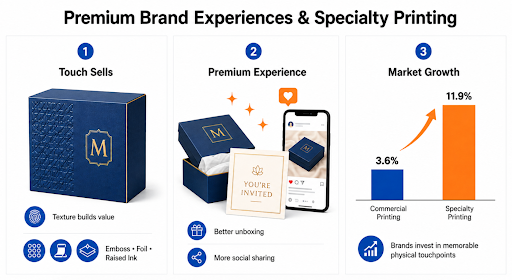
The Significance of Tactility
Touch has a long-standing link with customer decision-making, and a paper published in the Journal of Consumer Psychology outlines its importance in detail, pointing out that businesses can drive sales through tactility because humans have evolved to seek information through this core sense. In other words, we make decisions in part based on information delivered via our hands, so physically interacting with a product is as likely to determine whether a consumer chooses to buy it as the marketing blurb or a salesperson’s pitch.
Merely touching a product or its packaging significantly increases a consumer's purchase intention and willingness to pay by creating a sense of ownership.
The use of tactile materials and techniques like raised ink and embossing can serve this purpose especially effectively, with both packaging and marketing materials benefiting from this innate psychological incentive. It’s also a response to the decline in in-person retail experiences today, so the chances for a brand to impress a customer are reduced to a combination of digital content and the first postdelivery interaction with a product.
When consumers cannot physically touch a product, such as seeing it on a shelf or on screen, visual cues that strongly imply texture, like high-definition gloss, metallic reflections, or deep-set embossing, act as tactile compensation. These cues stimulate the brain’s mental imagery, reducing the customer's perceived uncertainty and elevating their immersion in the brand experience. Again, research supports this, with the Journal of Theoretical and Applied Electronic Commerce Research analyzing the visual-tactile cues brands use to convey premium experiences in an online shopping context.
The Elevation of Premium Brand Experience
Research by EY indicates the importance of perceived quality, with 75% of luxury brand customers placing it at the top of the agenda. The same study, which surveyed 1,211 people in 2025 found 96% of consumers in this market segment also feel in-store experiences are the optimal way for their needs to be met, with VIP treatment and personalization also a priority met by face-to-face interactions.
Emulating this in an environment where brands cannot directly engage with customers in the flesh is thus exactly what specialty printing provides. It also ties into shareability, which is part and parcel of premium brand experiences at a time when social media is where tastemakers influence purchasing decisions and audiences go looking for their next acquisition.
An event invitation printed with foil lettering can be snapped and showcased on Instagram or TikTok and convey the high-end nature of the evening ahead far more than flat, low-cost designs of the past. Likewise, product unboxing videos generate much more buzz if the packaging is of a premium nature, with printed elements embossed for that total tactility. When a customer sees a deep deboss or shimmering metallic foil, their brain simulates the physical feel of the product, making the brand feel instantly premium, even if it’s only seen on social media.
The Market Reality
What’s most apparent from the demand for premium brand experiences and its impact on the specialty printing market is not only how it’s influencing design choices, but how the broader printing market is being influenced. Higher-end options are enjoying 11.9% year-on-year growth, while the traditional commercial printing sector’s annual growth is around 3.6%, , according to a Fortune Business Insights 2026-2034 forecast.
Specialty value-add printing is growing because brands are desperate to create memorable physical touchpoints. Consumer expectations are moving further in this direction, so brands must adapt to remain relevant. This growth disparity reflects specialty printing's rising strategic value for brands.